Measuring, Not Estimating
May 15, 2026

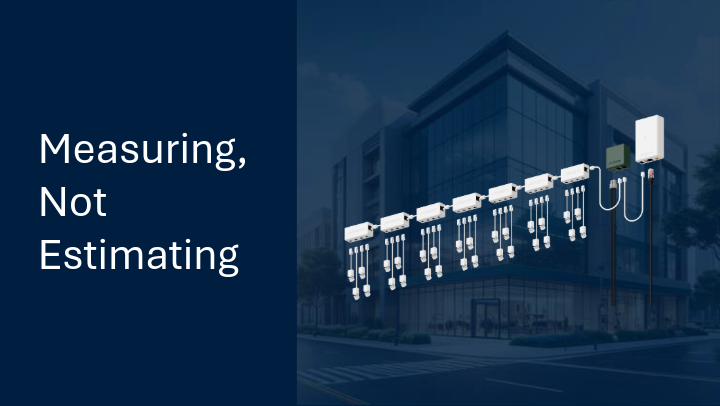
Why continuous power quality monitoring with AI diagnostics outperforms the traditional ESCO approach, sooner.
A thought-leadership paper for facility owners, financiers and policymakers in the Philippine energy efficiency market.
The Philippines, like most emerging markets, drives energy efficiency and conservation (EE&C) projects through the three-step audit process the profession has used for three decades: a walk-through (L1), a more detailed energy survey (L2), and finally an investment-grade audit (IGA) delivered by an Energy Service Company (ESCO). The process was built when measurement was expensive, intermittent and reserved for the possible retrofit of capital-intensive equipment.
This paper argues that the process should be inverted, and the IGA stage strengthened. The starting point of any serious EE&C engagement should be a comprehensive, granular, value-for-money measurement layer on the facility’s electrical backbone down to any significant load worth monitoring. Paired with analytics that interpret the data continuously, that layer turns the L1 walk-through into a single-day site familiarisation, lets the L2 survey emerge from the analytics platform itself, and reduces the IGA, where still required, to a calibration on a measured baseline rather than an engineering estimation of one. The headline benefit is timing: managerial insights begin within weeks of installation, the first operational interventions land within months, and the first energy efficiency project activity is bankable within the first year, well before the traditional cascade has even reached its L2 stage.
The full machine-learning overlay described later in this paper is arriving rapidly, but it is not uniformly available today. It does not need to be. Engineering judgement, scientific method and statistical inference, run against long-term, high-resolution, granular data, already make an IGA materially more bankable. The measurement layer is the part that must be invested in now; the AI layer is guaranteed to improve year on year, as are the insights, on the same scientific principles.
The cost case rests on executed and quoted projects, anonymised as Facility A through F. Six facilities aggregate 1,166 three-phase load monitoring points across about 229,200 square metres of gross leasable area (GLA), at a fully-commissioned cost of about PHP 45,000 per monitored load and PHP 228 per square metre of GLA. That total, for instrumentation that includes a 5-year cloud-dashboard licence, a 10-year-plus useful life and continuous M&V capability, is in the same order as a single IGA cycle for one comparable facility.
The financing implications are substantial. Philippine banks, leasing companies, development finance institutions and concessional climate funds can underwrite EE&C projects more confidently and across a wider universe of clients when the measurement layer is in place from day one.
The traditional ESCO model is not the only path to maturity and is unlikely to dominate the Philippines in the planning horizon that matters. Recent Department of Energy circulars, including a proposed categorisation of ESCO types, anticipate that structural diversification. The measurement-and-analytics-first model is a parallel and complementary path, and it produces results sooner.
The ASHRAE-style audit cascade has been a serviceable framework. It established an accepted accuracy vocabulary (±25% at Level 1, ±15% at Level 2, ±10% or better at Level 3) and a defensible basis for capital approvals. In the Philippines, RA 11285 translates this into a three-year cycle: an L1 walk-through, an L2 energy audit, and an investment-grade audit (IGA). The first L1 round is complete; the country is now in the L2 phase. Each step delivers progressive value at meaningfully higher cost. The concern, voiced by ESCOs working inside the cycle, is that little of what the L1 round recommended has been acted on, the process is becoming a compliance check rather than a route to action. And the engineering baseline at each stage remains, by definition, an estimate of a system the engineer can only observe for a fraction of the year. The instrumentation needed to remove that estimation has, in the last decade, become cheap enough to deploy from the outset, and rich enough to produce statistically meaningful insights within the first few weeks of collection.
Figure 1. Time-to-benefit under the traditional audit-led approach versus the measurement-first approach. Stratcon analysis.
The same shift is visible on the non-electrical side. Industrial-grade sensors for indoor air quality (CO₂, PM2.5, humidity), differential pressure, refrigerant temperatures and HVAC airflow are now available at a fraction of the cost they commanded a decade ago. Integrating those time-stamped streams into a single dashboard is an off-the-shelf exercise. The analytics layered on top can then surface insights an IGA cannot, including residual-life estimates for major equipment that trigger preventive-maintenance scheduling before a chiller, AHU motor or main transformer fails. The unplanned outage is a facility manager’s worst situation, and its cost in lost tenant revenue typically dwarfs every line item in the audit it would otherwise have appeared in.
Costs within the cascade grow exponentially rather than linearly. A walk-through can be completed in days at modest cost, but it is worth asking how many of its observations are ever implemented. A Level 2 survey with meaningful short-term measurement campaigns runs several multiples of the walk-through; the question there is whether it is being conducted for compliance or for genuine investment prioritisation, because the two produce different deliverables. The IGA, with its engineering models, calibrated simulations and risk-bearing recommendations, is several multiples again. By the time a project breaks ground, the cascade has consumed a meaningful share of both the available capital and years before a single intervention has been undertaken.
There is a behavioural cost as well. Each audit in the cascade tends to be commissioned, delivered, reviewed and then filed. The next cycle is years away. In the intervening period there is no operational signal that anything is drifting; the document on the shelf cannot prompt action it does not detect. The engineering baseline is fixed at the moment the audit concludes, then ages while financing closes; by year two of an engagement, the baseline is being reconstructed against operational drift, tenant churn, equipment failures, and a facility that has, in every meaningful respect, become a different facility. The cascade also produces a single point estimate of opportunity. It is largely silent on the long tail of small, distributed, intermittent inefficiencies that, in aggregate, often dwarf the headline items. Energy efficiency works at the margin. A continuous measurement layer behaves differently: it provides ongoing visibility of underperformance across a facility, and visibility carries its own behavioural pressure to act before deterioration compounds.
Any serious EE&C undertaking that produces guaranteed or contracted savings must satisfy the International Performance Measurement and Verification Protocol (IPMVP). For most projects of any consequence, particularly complete retrofits, that means IPMVP Option B (retrofit isolation with all-parameter measurement) or, in some cases, Option C at the whole-facility level. Option B requires permanent, properly specified instrumentation on the affected circuits, before and after the intervention, for the duration of the contract.
The cost of IPMVP-compliant measurement is therefore a sunk cost of any meaningful EE&C project. It will be incurred whether the project is preceded by an L1/L2/IGA cascade or begins with the instrumentation itself. If the measurement layer must exist regardless, the rational starting point is to install it first, use it to construct a measured baseline in 12 to 16 weeks rather than estimating one, and let the data identify the opportunities the audit would otherwise have been paid to find.
The ASHRAE framework is not wrong; its tiered design, qualitative at Level 1, engineering calculation at Level 2, intensive metering and simulation reserved for Level 3, encodes the economics of episodic measurement, which no longer hold. When the binding constraint flips, the optimal sequence flips with it.
“Smart metering” is a wide tent. At one end it covers low-resolution interval meters reporting kilowatt-hours every fifteen minutes, useful for tariff billing, insufficient for engineering. At the other end it covers highly accurate across one hundredth of a second power quality analysers (PQA) deployed for one to two-week diagnostic campaigns. What this paper describes is neither: a permanent, panel-resident measurement layer that operates at the resolution of a handheld PQA but does so continuously, on every monitored load, for the life of the facility.
From an electrical engineer’s perspective, a measurement layer must capture three things, not one. The basic operational picture (true-RMS current and voltage per phase, real and reactive power, power factor, energy) establishes the measured baseline. The disturbance picture (minimum and maximum values over 5-minute intervals, enabling the detection and trending of voltage sags, swells, load imbalance, and significant inrush-related RMS deviations) is what makes the data engineering-grade rather than tariff-grade. The harmonic picture, resolved to at least the 19th order, is where the modern non-linear loads in a commercial facility, variable-frequency drives on chillers, lifts and pumps, switched-mode supplies, EV chargers, leave their characteristic 5th, 7th, 11th, 13th, 17th and 19th signatures. Truncating at the 13th, as cheaper meters do, hides the early warnings of motor-bearing wear, drive-side capacitor degradation and transformer K-factor stress. Resolving through the 19th places the analytics in the same conceptual zone as IEC 61000-4-30 Class S, the standard used in power-quality disputes and grid-edge investigations.
The upstream backhaul has to match the sampling. Many low-cost “smart power monitoring” offerings on the Philippine market today are LoRaWAN-based and inherit the bandwidth and duty-cycle constraints of that radio standard. LoRaWAN was designed for low-power telemetry of slow-moving variables and cannot carry one-second-cadence current and voltage waveforms or the harmonic spectra the analytics depend on. The gateway density required for a full-size commercial facility also erodes the headline price advantage once honestly accounted for. Separately, the user-interface layer matters: a Philippine facility technician, not a data-science team, has to read the dashboard daily and act on it, and operator clarity should be tested with the actual people who will use it.
The same measurement layer that anchors energy management also anchors asset protection. Voltage and current unbalance, time-domain transients, harmonic distortion trends and CT-side asymmetries are leading indicators of transformer stress, capacitor-bank failure, motor degradation and switchgear faults. A facility that has invested in PQA-grade monitoring for energy reasons has, almost by accident, invested in continuous condition monitoring for its critical electrical infrastructure. For data centres, hospitals and BPO floors, that secondary benefit alone often justifies the deployment.
Granular data without analytics is overhead. What converts a high-resolution monitoring layer into a tool that changes operating decisions is the analytics that sit on top of it. A clarifying point upfront, because it matters for how the rest of this paper reads: this approach does not bypass engineering judgement. It changes where that judgement is applied. The methodologies used to interpret electrical data, characterising harmonic signatures, separating transients from steady state, classifying anomalies, calibrating measurement against established standards, remain the disciplines a Certified Energy Manager or chartered engineer brings to a Level 2 survey or an IGA. What modern statistical methods and AI change is the volume of data those disciplines can act on, and the speed of the work. The heavy lifting of pattern detection and first-pass diagnosis moves onto the software; the engineer’s attention shifts to verifying, pressure-testing and contextualising what the software has surfaced. The same shift is now visible across medicine, law and finance: AI does not replace the licensed professional but reshapes which parts of the day are spent on routine throughput and which on judgement. The verification layer matters more, not less, as the analytics improve.
Continuous high-quality measurement across the full spectrum of electrical indicators, instantaneous and historical (down to 5-minute intervals) current and voltage (minimum and maximum values), real and apparent power, power factor, frequency, total harmonic distortion, and harmonics resolved to at least the 19th on every reporting interval, produces a dataset large enough and structured enough to support statistically significant inference on the patterns, anomalies and disturbances that determine how a facility actually performs. The single most important property of that dataset is that no one can know, before installation, which slice of value will dominate the return because every facility is different.
Stratcon has catalogued over 36 distinct benefits across 6 categories that a comprehensive smart power monitoring deployment can produce or at least contribute to the data needs to deliver on the undertakings this paper suggests:
The catalogue is illustrative, not exhaustive. No two facilities exhibit the same dominant value driver. One facility will recover its instrumentation cost from after-hours load alone; another from chiller efficiency drift; a third from harmonic-driven transformer life extension; a fourth from sustainability-linked loan covenant compliance. Until the data is captured, no one, including the engineer who specified the system, can tell the owner which family will dominate the return. The honest position is that ROI cannot be known in advance. The implication is not that the case for instrumentation weakens; it strengthens, because the spectrum of insight is too valuable to leave undeployed waiting for an estimate that, by definition, cannot precede the data.
The deployment also unlocks a cascade of decision-making. The first wave is operational and tariff-side: short payback, no capex. The second is asset-management: preventive maintenance that extends equipment life and avoids unplanned-outage cost. The third is capital: properly scoped retrofits underwritten by a measured baseline rather than an estimated one. Each wave informs the next, and the financing structure of each is different. This cascading sequence is what continuous measurement makes possible and what episodic auditing cannot.
None of this is speculative. It is what continuous high-resolution measurement, combined with engineering analytics, delivers in operational deployments today, to the facility manager opening a dashboard on a Monday morning and the CFO reviewing a monthly performance pack. The science is settled; the engineering discipline is conventional; the practical, everyday value is real.
Three developments are converging on the building energy domain over the next 24 to 36 months. Time-series foundation models trained on order-of-magnitude-larger datasets than any single vendor could collect are beginning to outperform purpose-built forecasters with little or no per-site tuning. Large-language-model interfaces are collapsing the gap between an operator’s question and the data infrastructure’s answer; the natural-language energy console is no longer a research demonstration. Cross-portfolio learning, transferring insights derived from one facility, with appropriate privacy preservation, to comparable facilities, is reducing the marginal cost of intelligence on each new asset onboarded. None of these capabilities requires additional hardware once a comprehensive, granular smart power monitoring installation is in place. They are software upgrades to a hardware decision correctly made at the start.
The numbers below are drawn from a mixed group of clients for which Stratcon has delivered, or is contracted to deliver, comprehensive smart power monitoring infrastructure on a turnkey basis. The portfolio is anonymised; the deployments and costings are real. Costs reflect fully installed and commissioned scope: hardware, cabling, breaker kits, enclosures, certified installation labour, project insurance and software licensing.
The architecture deployed across these facilities is built around a modular smart power monitoring solution, referenced here because the cost figures reflect its specifications, not as a vendor recommendation. The solution separates the gateway from the power module. Each pair connects to a maximum of 7 CT Hubs, with the last one reaching up to 100m from the power box, each accommodating up to four external current sensors capturing current: split-core CTs rated at 50 A, 100 A, 200 A or 400 A for cabled circuits, or Rogowski coils (12 cm or 19 cm) for busbar and large-conductor applications. Voltage flexibility covers from single-phase 100–240 V up to three-phase 480 V natively; MV switchgear is accommodated through instrument transformers. Each deployment includes a 5-year cloud-dashboard licence with firmware updates; after year 5, the system continues to operate for the life of the product through MODBUS TCP integration with the facility’s building management system, with cloud-dashboard renewal optional. The cost figures that follow should be read against this architecture.
“Loads” refers to the count of three-phase load monitoring points in each facility, calculated as the sum of all current transformers and Rogowski coils deployed, divided by three. The arithmetic reflects the physical architecture: every three-phase measurement requires three current sensors, one per phase. The figure reports the count of physically measured three-phase circuits, not the count of CT Hubs or any other intermediate enclosure.
First, cost per monitored load falls within a tight band, PHP 37,000 to PHP 54,000, across deployments ranging from 103 to 290 loads. The weighted average is about PHP 45,000 per load, or about PHP 9,000 per load per year over the 5-year licence period. This is the unit economics owners and financiers should benchmark, not the headline contract value.
Second, cost per square metre of GLA falls as facilities scale. The smallest deployments in this set run above PHP 300/sqm; the larger facilities trend toward PHP 200/sqm, with the largest approaching PHP 190/sqm. The driver is the amortisation of fixed costs, gateway hardware, project mobilisation, electrical enclosures, IT cabling, across a larger monitored load count. This is a direct consequence of the modular architecture of the underlying platform.
| Reference | Approx. GLA (sqm) | Loads | Project cost (PHP, ex-VAT) | PHP / load | PHP / load / year (5-yr licence) | PHP / sqm GLA |
|---|---|---|---|---|---|---|
| Facility A | 55,000 | 193 | 10,435,066 | 54,068 | 10,814 | 190 |
| Facility B | 19,000 | 160 | 6,608,927 | 41,306 | 8,261 | 348 |
| Facility C | 62,000 | 268 | 11,603,211 | 43,296 | 8,659 | 187 |
| Facility D | 19,200 | 103 | 3,765,498 | 36,558 | 7,312 | 196 |
| Facility E | 19,000 | 152 | 6,296,439 | 41,424 | 8,285 | 331 |
| Facility F | 55,000 | 290 | 13,528,136 | 46,649 | 9,330 | 246 |
| Portfolio total / weighted avg. | 229,200 | 1,166 | 52,237,277 | 44,800 | 8,960 | 228 |
Third, a comparator for the local reader. For a Grade-A office tower of, say, 25,000 sqm GLA, the full PQA-grade instrumentation footprint costs roughly PHP 5 to 6 million. That is in the same order as a single Investment-Grade Audit cycle on the same facility, applying international IGA benchmarks of USD 0.10 to USD 0.30 per square foot (roughly PHP 1,500 to PHP 4,500 per square metre at current FX). For a tenant of that size, the instrumentation is typically recoverable within one to two Meralco billing years once a meaningful share of the available HVAC and demand-management optimisation is captured. Realised savings on continuously monitored Philippine commercial facilities run from 5% to 20% of pre-intervention consumption, largely depending on the HVAC operation, a centralised chilled-water plant with extensive after-hours setpoint discretion sits at the upper end; a smaller facility running mostly on VRF with limited central control sits at the lower end. Even the lower bound clears the cost of the instrumentation in a year or two.
Fourth, the variability in cost per load across facilities is not random. The lowest unit-cost deployment was an early one, scoped before later additions such as a sustainability and billing module became a client requirement. The highest unit cost belongs to a facility with high panel density relative to GLA, where every load is genuinely worth monitoring. The unit cost is sensitive to the facility’s electrical topology and the analytics scope agreed at contract, both of which can be quantified upfront.
The comparison is therefore not between an audit and an instrumentation project. It is between an audit cycle that produces a snapshot estimate, and an instrumentation project that produces a continuous measured baseline at similar cost and with a 10-year-plus useful life.
If the engineering case is that measurement should come first, the financing case is its corollary. An instrumented facility is a more bankable facility. A measured baseline is a lower-risk baseline. Continuous M&V is lower-risk M&V. The cash flows that underwrite an EE&C project become observable in near-real-time rather than estimated in a calibration model. Every step of that translation reduces the risk premium a lender or investor must price into the transaction.
The traditional Energy Services Company (ESCO) model, shared-savings contracts with bonded performance guarantees, 10- to 15-year terms, third-party financing wrapped around a savings-based repayment structure, works in the United States and Western Europe because it sits on top of three decades of institutional accretion. Court-tested contract precedent. M&V capacity housed inside the customer organisation and the ESCO concurrently. Surety markets willing to underwrite performance bonds at workable premiums. A regulatory regime that recognises and protects the resulting cash flows. None of those preconditions is fully present in the Philippines.
Two specific frictions matter most. The first is financial: Philippine ESCOs have a strong technical arm but do not yet carry the balance-sheet capacity to absorb shared-savings risk at the scale that multinational ESCOs do. Performance guarantees of the kind that make a mature-market contract bankable would, if applied wholesale to a domestic provider, exceed its working capital several times over.
The second is legal and cultural, and it sits squarely on risk. For a traditional ESCO arrangement, the ESCO carries the significantly larger share of risk exposure. The ESCO is asked to guarantee energy savings over a 10 to 15-year horizon against a baseline it does not fully control, while the client is asked to sign indemnity clauses, dispute-resolution mechanics and termination provisions that, in a Philippine board context, read as exposure to be avoided. Larger corporations negotiating as clients tend to use their economic weight to further push terms onto a provider that, in the local market, does not have the balance sheet to absorb them, the ESCO sector here is too young for that asymmetry to be sustainable. Move in the other direction, and the problem inverts: an experienced ESCO offering a credible performance guarantee produces a contract complex enough that the client grows wary of what it will sign. The Philippine market has already seen cases in which an ESCO was removed from an energy efficiency project that, on paper, the contract was designed to deliver. The legal framework, and the institutional ability to read these contracts confidently, remains underdeveloped. The route forward is a culture, among ESCOs, clients, banks and financing institutions, of sharing risk reasonably and proportionally to who is best placed to bear each piece of it. That is the connecting thread to the financing ecosystem proposed in the next section.
The constructive answer is not to import the model wholesale, nor to wait twenty years for institutional capacity to catch up. It is to build an ecosystem in which different financing institutions provide different products to different clients, scaled to the client’s size, balance sheet, risk profile and appetite. Commercial banks can underwrite term loans against a measured baseline. Development finance institutions can take longer-tenor risk on portfolio-scale deployments. Concessional climate funds can absorb first-loss tranches where commercial returns require it. Leading to savings for clients – regardless of the financing mechanism.
What ties the ecosystem together is the measurement layer. A PQA-grade installation, with IPMVP Option B-native M&V, gives a lender the same instrument as a regulator, the same instrument as an OEM, the same instrument as an insurance underwriter. The cost of due diligence falls because every institution is looking at the same data. The cost of monitoring falls because the instrumentation is already in place. Smaller transactions become bankable because the due-diligence overhead no longer dominates the economics.
The Department of Energy has signalled, in two draft Department Circulars currently out for public consultation, the structural diversification described above. One circular addresses the endorsement of energy efficiency projects for fiscal incentives; the other proposes a categorisation of ESCO types that explicitly breaks from the single-archetype model. The intent is to mobilise the market by allowing different ESCO archetypes to operate in segments suited to their capacity and risk profile, rather than gating all market participation behind a traditional ESCO definition. Stratcon has submitted detailed comments on both drafts, recommending in particular that the regulations formally recognise Continuous Measurement and Verification, define Smart Power Monitoring with specificity, and acknowledge an Energy Optimisation Service Agreement as an alternative contracting vehicle alongside the traditional Energy Savings Performance Contract. Smart power monitoring and analytics-driven EE&C are a natural complement to that direction: a parallel pathway that lowers the technical-capacity bar for new market entrants while preserving the integrity of measurement and verification.
A paper of this kind would be incomplete without acknowledging the gap between the architecture of Philippine EE&C policy and its actual market traction. The diagnosis was articulated, in plain terms, at the Senate Committee on Finance hearing on the proposed 2026 Department of Energy budget in October 2025. Senator Sherwin Gatchalian, principal author of Republic Act 11285, observed that 9,278 establishments had registered as Designated Establishments under the EE&C Act, against a universe of about 150,000 firms classified by the Bureau of Internal Revenue as large taxpayers, those reporting annual gross sales above PHP 1 billion. One assumes that these 150,000 taxpayers are at the very least a Type 1 Designated Establishment. National energy savings to date stand at 0.72% of total consumption. His summary, on the record, was three Filipino words: “malayo pa tayo.” We are still far.
The fiscal-incentive pipeline tells the same story in a different form. Under the Corporate Recovery and Tax Incentives for Enterprises Act (Republic Act 11534), as amended by CREATE MORE (Republic Act 12066), qualified EE projects endorsed by the DOE and registered with the Board of Investments are entitled to an Income Tax Holiday equivalent to 50% of capital investment, alongside other deductions. The administrative architecture is fully assembled: endorsement guidelines, registration procedures, and the refinements proposed in the two draft Department Circulars on which Stratcon has submitted comments. The composition of the pipeline itself, however, reveals the misalignment.
Per the BOI’s own list of submissions, thirteen projects have so far been lodged for CREATE incentives under the EE&C window. Ten are solar PV installations of various configurations and one is an EV taxi modernisation and smart mobility infrastructure project. Only two are energy efficiency and conservation projects in the conventional sense: both are chiller-based Energy Efficiency Performance Contracts structured as Third-Party Project Developer (TPPD) engagements, and both are registered — one already carrying a Certificate of Registration, the other in commercial operation since March 2024 and registered in substance.
This composition raises a question the incentive design was never asked to answer: why, in a pipeline established to mobilise energy efficiency and conservation investment, are more than three-quarters of the submissions solar PV systems? The CREATE pathway, as currently used, is functioning predominantly as a fiscal corridor for solar PV self-generation by individual corporate hosts, not as a mechanism mobilising third-party-financed energy efficiency retrofits at the scale and breadth the law was designed to unlock. The two TPPD chiller registrations are the exception, not the trend.
The fuller picture surfaced recently at a GIZ-hosted workshop on energy efficiency in the Philippines. During the open discussion, an ESCO participant put on the record that it had filed five successive applications for BOI registration of EE projects without securing the CREATE benefits, and pressed to address the cumbersome process and documentary requirements. The remark was not a one-off complaint; it is the experience reported, in similar terms, by ESCO companies and project developers.
This paper does not claim that a measurement-and-analytics-first model fixes the execution gap. It involves enforcement, capacity, awareness, professional development, and the slow accretion of trust between all stakeholders. An instrumentation platform does not, by itself, change any of those things.
The narrower claim is more useful. Start with the data layer. The single most consistent obstacle to EE&C project execution in the Philippines today is not the absence of incentives, nor a lack of engineering competence, nor scepticism about the savings, nor the EE&C Law. It is the absence of a credible, low-friction, evidence-grade baseline on which a CFO, a banker or a regulator can rely. The audit cascade was supposed to deliver that baseline; the registration and CREATE numbers show it has not done so at scale. A permanent measurement layer does deliver it, at a cost that does not require board-level deliberation.
Once the data layer exists, the role of analytics, and within that, of AI, is to do the work that the institutional infrastructure was supposed to do but cannot. Continuous M&V substitutes for the M&V capacity that domestic ESCOs and customer organisations have not yet built at scale. Automated fault detection substitutes for the certified-energy-manager bench depth the country has not yet trained. Persistence-of-savings verification, computed at every reporting interval, substitutes for the surety markets and performance-bond underwriters not yet present. None of this requires the institutional gap to close first. It works around the gap by doing in software what institutions would otherwise do in person.
Whether the parallel pathway will, in practice, draw thousands of new entities into meaningful EE&C action over the next five years cannot be known in advance. The alternative, doing more of what has, to date, produced 9,278 registrations out of a universe of 150,000, is unlikely to deliver a materially different result on its own. The constructive position is to let the two pathways operate alongside each other and allow the market to choose.
The ESCO sector in the Philippines, and in comparable emerging markets across Southeast Asia, will not reach the structural maturity of the US and Western European markets within the planning horizons policymakers and financiers actually care about. This is not a criticism. It is a recognition that the institutional foundations on which the mature-market model rests took decades to assemble and depend on enabling conditions not yet locally present at scale.
The US Federal Energy Management Programme has been issuing Energy Savings Performance Contracts since the early 1990s. European Energy Performance Contracting matured alongside the EU energy efficiency directives across the 2000s and 2010s. Behind each is a stack of supporting infrastructure: standardised contract templates field-tested in court, M&V capacity diffused through utilities and large customers, performance-bond underwriters, a body of trained certified energy managers and certified measurement and verification professionals, and a regulatory regime that classifies energy savings as a settleable financial product. The Philippine ESCO sector has technical depth, but the supporting institutional infrastructure is, at best, partial.
Republic Act 11285 is an exceptional piece of legislation. Read on its own, it would not be out of place in the energy-efficiency statute book of any OECD economy. The challenge is that an Act, however well drafted, cannot manufacture the enforcement bandwidth, certified-practitioner bench, standardised contract templates, surety market and trust capital that the mature-market ESCO model takes for granted. Surety underwriters remain reluctant to price performance bonds against multi-year shared-savings contracts in the absence of court-tested precedent. None of this is criticism of the institutions involved; it is a description of the time it takes to assemble the supporting machinery at scale.
Mobile money in Sub-Saharan Africa did not arrive by replicating retail banking and waiting decades for branch networks to mature. It skipped the branch network and routed financial services over the infrastructure that did exist, the mobile phone. The institutional preconditions of retail banking were not assembled in advance; a different model was deployed in their absence. The argument for energy efficiency in the Philippines is structurally analogous. The institutional preconditions of the traditional ESCO model, bonded performance guarantees, deep M&V capacity, court-tested contract precedent, are not the prerequisite they appear to be if a different model is available.
A permanent high-resolution measurement layer is, by itself, the closest thing the Philippine EE&C market has to a substitute for the institutional infrastructure it lacks. It produces a measured baseline that does not depend on a certified-energy-manager bench the country has not yet built, continuous M&V that does not depend on customer-side capacity the mature-market model assumes, and persistence-of-savings verification that does not depend on surety markets not yet present. The analytics layer, statistical methods today, AI tomorrow, converts that data into operational and financial decisions at a pace and cost the institutional route cannot match. The result is not a copy of the mature-market model running on slower hardware; it is a structurally different model designed for the conditions that exist.
For facility owners, there is no reason to wait for a domestic ESCO market to mature into something it is unlikely to become within the relevant decision horizon. The instrumentation can be commissioned now, the analytics layered on, and the financing arranged through whichever ecosystem institution fits the asset and balance sheet, from a 200-sqm SME with a single panel to a 60,000-sqm Grade-A tower with hundreds of monitored loads. For policymakers, the recent DOE Department Circulars point in the right direction. Diversifying ESCO archetypes and treating measurement infrastructure as a legitimate parallel pathway are the policy moves that allow the leapfrog to occur. The traditional ESCO model is not obsolete, it continues to deliver in mature markets, but it is unlikely to be the dominant Philippine vehicle in this decade. The sector wants results; the instrument that can deliver them is the one that does not require the institutional preconditions to be assembled first.
The recommendations are scoped to three audiences: facility owners, financiers, and the policy and regulatory community. Each should be read against the central thesis of this paper: measurement, not estimation, is the foundation on which an EE&C engagement should be built.
Treat the measurement layer as infrastructure, not a project deliverable. Specify it once, install it across the portfolio, and let the analytics and the financing organise themselves around it. Where an L1 walk-through is useful as familiarisation, keep it; where an IGA is contractually required for a specific financing instrument, scope it as a calibration on a measured baseline rather than an estimation from first principles. Insist on open data egress, MODBUS, REST API, or MQTT at minimum, to preserve optionality over future BMS, AI and financing partners.
A continuously instrumented facility is a fundamentally lower-risk underwrite than an audit-baselined one. Develop product structures that price that risk reduction explicitly. For larger portfolios, tie loan covenants to monitored performance rather than estimated performance; for smaller transactions, allow the measurement infrastructure itself to qualify for green or sustainable finance treatment. The data infrastructure is the asset that survives every contract renegotiation, BMS upgrade and tenant changeover for the life of the facility.
Continue the direction of travel signalled by the recent DOE Department Circulars. A categorised ESCO framework, properly designed, opens the market to participants whose engineering competence is real but whose balance sheet would never carry a performance guarantee. Recognise measurement-plus-analytics-led EE&C as a legitimate pathway in its own right, not an inferior substitute for full-service ESCO contracting. Where possible, harmonise M&V expectations across DOE, ERC and the development finance community so that a single instrumented baseline can serve regulatory, contractual and financing purposes simultaneously.
The next three to five years will bring AI capability improvements at a rate historically associated with the early phases of foundational technology shifts. Time-series foundation models, natural-language operator interfaces and cross-portfolio transfer learning will, on current trajectory, render the analytical heavy lifting of an IGA something an instrumented facility does in software, continuously, at marginal cost. Facilities instrumented today inherit those capabilities for free; those waiting on the audit cascade will inherit them on a delay measured in years. The reframe is conservative: when the price of measurement collapses, the rational response is to measure more, not to keep estimating. The rest follows.
Colin Steley is Managing Director of Stratcon Power Services Philippines, Inc. His two-decade career across the Philippine and Southeast Asian energy sector spans the origination of the country’s first feed-in-tariff utility-scale solar project (SACASOL, 22.5 MW), a US$400+ million distributed-energy investment pipeline at the Asian Development Bank, and country-manager roles in Vietnam and the Philippines. He serves on the boards of PE2 and PSSEA.
About the firm. Stratcon integrates smart power monitoring, AI-driven HVAC optimisation, transformer protection and environmental sensing. Limitations: cost figures reflect quoted scope, PHP ex-VAT, for the anonymised reference set only; not investment, legal or accounting advice.

.jpg)


.svg)