
.jpg)
The traditional Energy Service Company model is built on a simple premise: a well-capitalized entity audits a facility, designs an intervention, finances the capital expenditure, installs equipment, and recoups its investment from guaranteed energy savings over time. It is a model that has served mature markets well — and it is being disrupted.
The disruption comes from two converging forces. The first is the dramatic decline in the cost of comprehensive smart power monitoring hardware. Multi-circuit monitoring systems that would have commanded hundreds of thousands of pesos a decade ago are now available at a fraction of that cost, capable of capturing granular, real-time data across every circuit, load, and piece of equipment in a facility’s electrical distribution network. The second is the maturation of artificial intelligence and machine learning as applied to energy data — platforms that can ingest millions
of data points from a monitored facility and deliver actionable insights that previously required expensive specialist consulting.
Together, these forces fundamentally change who can deliver energy efficiency and how.
The Reality of the ESCO Market in Southeast Asia
In countries like the Philippines — and across most of Southeast Asia — the ESCO industry
does not resemble the textbook model. The textbook presupposes an entity that is
simultaneously a technical powerhouse and a financial institution: capable of designing complex energy interventions, deploying capital across multiple concurrent projects, absorbing
performance risk over multi-year contract periods, and managing a portfolio of savings
guarantees against its balance sheet.
The reality is different. Most ESCOs in the Philippine market are MSMEs. They possess strong, often exceptional, technical understanding of a particular technology or service domain —
HVAC optimisation, lighting systems, building automation, solar integration, power quality
analysis. What they do not possess is the balance sheet to finance more than one or two
projects simultaneously. The Energy Savings Performance Contract, which requires the ESCO to bear all upfront capital costs and recover them from future savings, is a financing model that inherently favours scale. A small ESCO with deep technical expertise but limited capital is
structurally excluded from the very market its skills are needed to serve.
This is not a Philippine-specific problem. It is the fundamental constraint on ESCO market
development across emerging economies. And it is precisely the constraint that smart power monitoring and AI-driven energy analytics are positioned to break.
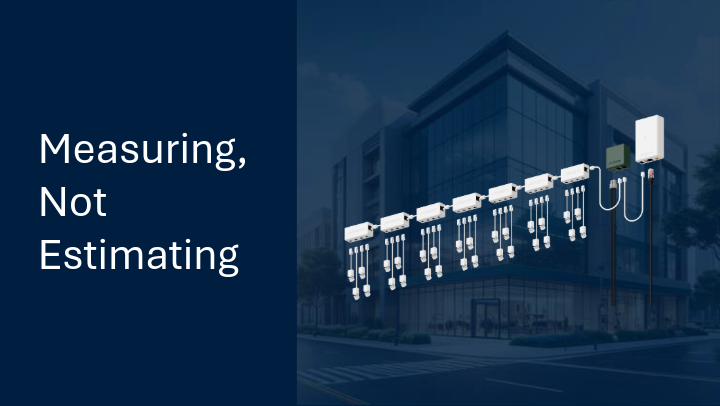
Consider an alternative approach. An ESCO deploys comprehensive smart power monitoring across a commercial building, a hospital, or a factory. Current transformers are installed on
every distribution panel and major circuit. Data flows continuously to a cloud-based analytics platform. Within days, the system is capturing granular consumption data across all common electrical indicators and variables — active and reactive power, voltage, current, power factor, harmonics, demand profiles, load curves — at intervals measured in seconds, not months.
An AI processor ingests this data and establishes a dynamic baseline: not a static snapshot
from a single audit visit, but a living model of how the facility actually consumes energy, hour by hour, day by day, across seasons and operational cycles. From this baseline, the platform
identifies anomalies, inefficiencies, and opportunities that no periodic energy audit could detect. HVAC systems cycling outside scheduled hours. Lighting circuits energised in unoccupied
zones. Chillers operating at suboptimal set-points. Equipment degradation patterns visible in power quality data weeks before they would manifest as failures.
The AI does not merely identify problems. It generates solutions — load scheduling
recommendations, set-point optimisations, demand management strategies, predictive
maintenance alerts — and continuously monitors whether those solutions are delivering the
projected savings. Facility managers receive real-time visibility into their energy consumption and actionable guidance to optimise operations with zero unplanned downtime. The savings are not theoretical; they are measured, verified, and reported continuously through what the industry terms Continuous Measurement and Verification.
This is not a future scenario. It is commercially deployed today, generating measurable savings in facilities worldwide. And critically, it does not require the ESCO to have a massive balance
sheet. The capital investment is in monitoring infrastructure and analytics capability, not in
replacing chillers or retrofitting entire HVAC systems. A technically competent MSME-scale
ESCO can deploy this model across multiple clients simultaneously, delivering verified energy savings without bearing the capital burden of traditional performance contracting.
The Philippine Department of Energy is currently developing two foundational circulars that will shape the ESCO industry and the fiscal incentive framework for energy efficiency projects for years to come: the Strengthening of the ESCO Industry circular and the Omnibus Guidelines for the Endorsement of Energy Efficiency Projects for Fiscal Incentives.
These are welcome and necessary regulatory initiatives. As currently drafted, both circulars are built around the traditional ESCO model. The ESCO definition assumes an entity that covers all funding at no upfront cost. The mandated contracting vehicle is the Energy Savings
Performance Contract. The project classifications assume equipment replacement as the
primary savings mechanism. The measurement and verification framework — to the extent one exists — is oriented toward static, before-and-after comparison.
If these circulars are finalised without accommodating the technology-enabled disruption
already underway, the Philippines risks codifying yesterday’s model into tomorrow’s regulation. Smaller, technically capable ESCOs will remain locked out of meaningful market participation.
Monitoring-driven savings — which deploy faster, cost less, and are continuously verifiable — will have no regulatory home. A high percentage of Designated Entity (DE) facilities that most need energy efficiency interventions will continue to be underserved, because the only delivery model the regulation recognises is one that requires capital they cannot access through a
traditional ESCO approach.
Policy must recognise that energy baselines can be established through continuous monitoring, not only through periodic energy audits. That savings can be verified dynamically through AI-driven Continuous M&V, not only through episodic pre-and-post comparison. That a Techno-Financial Report derived from months of comprehensive monitoring data carries at least the
analytical weight of a traditional energy audit conducted on a limited, constrained time frame. And that the “Energy Optimisation Service Agreement” — where an ESCO deploys monitoring infrastructure and delivers ongoing savings through continuous analytics — is as legitimate a contracting model as the traditional Energy Savings Performance Contract (ESPC).
This requires new definitions in the regulatory framework. Continuous Measurement and
Verification must be defined as a recognised methodology, grounded in international protocols like IPMVP Option C. Smart Power Monitoring must be defined with the specificity it warrants — it is referenced throughout RA 11285 and the DOE Building Code but remains undefined in the circulars that operationalise these laws. An Energy Optimisation Service Agreement, or similar, must be recognised as an alternative to the ESPC, with equivalent accountability provisions but a service-based rather than capital-intensive structure.
These are not radical proposals. They reflect the direction of energy management globally. They are consistent with the existing Philippine regulatory architecture. And they are essential if the DOE’s circulars are to remain relevant as the technology landscape continues to evolve.
Republic Act 11285 — the Energy Efficiency and Conservation Act — and the CREATE MORE
Act together establish a powerful fiscal incentive framework for energy efficiency projects:
Income Tax Holidays, Enhanced Deductions, duty exemptions, and capital investment
recoupment. These incentives exist to accelerate the national energy transition. But the
endorsement framework being developed to administer them must not inadvertently restrict their reach. Why lower the RA11285 threshold to 50,000kWh per year, but not build in the incentive
structures for the smaller DE category?
As currently drafted, the Omnibus Guidelines for EE Project Endorsement channel fiscal
incentives through a narrow implementer typology: ESCOs operating under ESPCs, or entities self-financing with their own capital. A hospital that takes a bank loan to finance an energy
retrofit falls outside both categories. An MSME accessing a DOE-JICA or ADB credit line for
energy efficiency improvements has no clear pathway to endorsement. A leasing company
financing equipment for an end-user has no defined role in the framework. These are not
hypothetical scenarios; they are the dominant financing modalities for MSME-scale energy
efficiency projects, and RA 11285 itself does not restrict incentive eligibility to ESCO-delivered or self-financed projects.
Policy must be financing-modality neutral. The source of project funding — whether equity, debt, lease, blended finance, development finance, or performance contracting — should not
determine whether a project qualifies for incentives that are designed to reward energy savings outcomes. The endorsement framework should classify projects by what they achieve, not by how they are financed. Endorsement fees must be proportionate to project scale, so that a PHP 1 million MSME project is not burdened with the same compliance costs as a PHP 100 million industrial deployment. And endorsement validity must accommodate the phased implementation
timelines that multi-site and loan-financed projects require.
The convergence of affordable smart power monitoring, AI-driven analytics, and a maturing
regulatory framework presents the Philippines with a genuine opportunity to leapfrog the
limitations that have constrained ESCO market development across Southeast Asia.
The revised approach being drafted by the DOE — if it incorporates the definitional and
structural adjustments the market needs — should enable a new generation of technically
capable, technology-enabled ESCOs to participate, grow, and evolve within the ESCO market. These are not the traditional balance-sheet-heavy ESCOs of the textbook model. They are
agile, technically specialised entities that leverage smart monitoring and AI to deliver verified savings at a scale and speed that traditional approaches cannot match.
But the regulatory framework must meet them halfway. It must include definitions for Continuous M&V Smart Power Monitoring, and Energy Optimisation Service Agreements. It must create project classifications — like the proposed Energy Monitoring and Optimisation Project — that give monitoring-driven approaches a regulatory home. It must ensure that the M&V framework being developed is the most robust section of the regulation, not an afterthought relegated to an absent annex, because M&V is the mechanism through which every savings claim, every incentive dollar, and every tonne of avoided CO₂ is validated. And it must ensure that the fiscal benefits Parliament intended under RA 11285 actually reach the MSMEs and facilities where the energy transition will be won or lost.
Get this right, and the result is straightforward: more energy efficiency projects reaching more facilities, more realised savings verified through transparent and continuous measurement,
reduced carbon emissions tracked and auditable, better facility management informed by real-time data and predictive analytics, and broader compliance with RA 11285 — not as a
regulatory burden, but as a natural consequence of the monitoring infrastructure that good
energy management requires.
The technology is ready. The market need is urgent. The policy framework is being written now. The suggested process could fast track the established approach from ten years of undertaking
a variety of different Energy Audits and requirements down to one, with real measurable impact and savings. This is the moment to ensure it is written for the future, not the past.



.svg)